• Head Office: Unit 502, 5th floor, No. 222, Kashani Ave, Tehran
  • Working Hours: Sat to wed, 8.30 AM - 5 PM (Tehran Time)
  • Phone

    +989121536145

Vinyl Acetate Customs Clearance in Iran (HS Code + Documents & Permits)
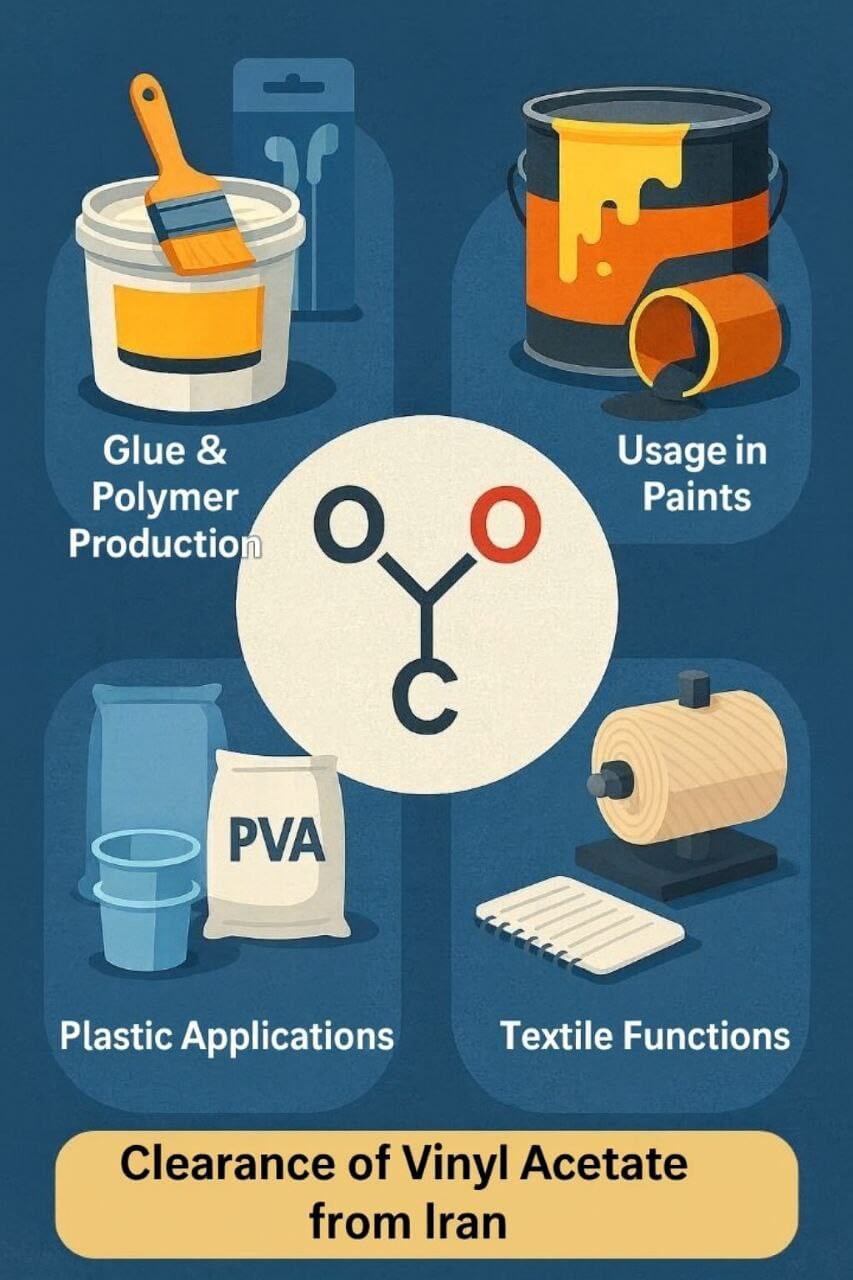
Vinyl acetate is one of the essential and widely used chemical compounds across industries. Owing to its unique properties, it plays a key role in producing various industrial and consumer products. Major applications include polymers, adhesives, paints, and coatings. Given these uses, importing vinyl acetate is highly important, and understanding the key points in its customs clearance is crucial for companies and importers.
Process explanation for clearing this product

To estimate time and costs for Vinyl Acetate customs clearance, contact the Saba Tarkhis experts.

Instant free consultation

1) Industrial Applications of Vinyl Acetate

Thanks to its specific chemical and physical characteristics, vinyl acetate has diverse applications across multiple industries:
Adhesives: A primary feedstock for pressure-sensitive adhesives (PSAs) and water-based adhesives. These are widely used in packaging, construction, and automotive.
Paints & Coatings: Acts as a resin component in paint and coating formulations. Using vinyl acetate in protective/decorative coatings improves adhesion and durability.
Plastics & Polymers: Used to produce vinyl co-polymers such as polyvinyl alcohol (PVA) and ethylene-vinyl acetate (EVA) for plastic products, packaging, footwear, and home goods.
Textiles & Paper: Serves as a plasticizer and coating agent, enhancing strength/appearance and enabling water-/moisture-resistant finishes.

2) Specialist Notes for Vinyl Acetate Clearance

1. Required Permits

Owing to chemical sensitivities and broad applications, clearing vinyl acetate demands high diligence and compliance with complex regulations.
For importing vinyl acetate, obtaining permits from relevant authorities is essential, such as:
Health permit from the Ministry of Health: Required due to uses in sensitive adhesive/coating production to ensure health and safety standards.
Environmental permit from the Department of Environment: Due to specific chemical considerations, environmental controls are applied to ensure safe import and no adverse ecological impact.

2. Quality & Safety Standards

Vinyl acetate must be imported in line with international quality standards, including: chemical testing by authorized customs labs and compliance with national standards of Iran and international standards such as ISO.

3. Customs Tariff (HS Code)

For importing vinyl acetate, the tariff code 29153200 applies. This HS code defines duties/taxes associated with the product. Importers should use it for accurate duty calculations.

4. Duties, Taxes & Ancillary Costs

Importers should carefully calculate total landed cost, including: customs duties (based on customs value and import type), value-added tax (VAT), and where applicable testing/quality assessment charges requested by the Standards Organization.

3) Special Conditions for Vinyl Acetate Import & Export: A Complete Guide

Vinyl acetate is highly significant in international trade due to its broad industrial use. Iran, driven by industrial demand, mostly imports this material; domestic production is very limited. Thus, understanding customs requirements and available facilitations is vital for traders.

Importing Vinyl Acetate into Iran

Given wide industrial applications, Iran imports large volumes of vinyl acetate. Main sources include:
China, Germany, South Korea, and Japan leading global producers with high capacity and strong quality standards supplying a major share of Iran’s needs.
Import volumes: Customs data indicate annual imports exceed several thousand tons due to broad demand in adhesives, coatings, and plastics, with steady growth alongside construction and manufacturing activity.

Global Exports of Vinyl Acetate

Production & export leaders: China and the United States are the largest producers. China dominates global markets via scale and competitive pricing; the U.S. holds significant share with high-quality, advanced production. Japan and Germany are also major exporters.
Global market: The vinyl acetate market is valued at about 7 billion USD, with leading producers capturing most of the value. Rising multi-industry demand continues to lift exports worldwide.

Top Importing Countries

Developed economies such as Germany, France, and the United States—and Asian markets like India and Türkiye are among the largest importers, driven by strong chemical and manufacturing sectors.

4) Required Documents for Vinyl Acetate Clearance

Clearing vinyl acetate—an essential chemical—requires specific documentation. These not only facilitate processing but also ensure legal compliance and quality standards.
1. Commercial Invoice
Must include: seller/buyer details (name, address, contact), invoice date/transaction date, product details (name, type, technical specs, quantity) consistent across documents, payment terms (e.g., LC or cash), and product value with currency.
2. Bill of Lading
Transport document listing: carrier name, mode (sea/air/road), loading/delivery dates, and shipment details (weight, dimensions, packaging) for safe transit and smooth clearance.
3. Certificates of Quality
Provide lab test results (chemical/physical evaluations proving quality and safety) issued by accredited laboratories to avoid legal issues.
4. Health & Environmental Permits
Health permit (Ministry of Health) confirming compliance with sanitary standards; environmental permit (Department of Environment) confirming ecological compliance and absence of hazards.
5. Customs Declaration
Includes shipment specifications (type, quantity, value), HS code 29153200 entered precisely, import date, and other logistics details.
6. Identification Documents
Importer identity verification: national ID and tax number for legal registration and clearance.
7. Certificate of Origin
States the producing country and certificate issue date for tariff preferences and trade restrictions evaluation.
8. Shipping Documents
Includes transport receipts and delivery confirmations to evidence arrival and hand-over.

Important: any mismatch or omission can delay clearance or cause legal issues ensure all documents are complete and consistent.

5) Best-Practice Path for Vinyl Acetate Clearance in Iran

For a fast, safe clearance, follow this path:
1) Pre-order technical alignment (MSDS, grade, packaging, HS code 29153200)
2) Obtain preliminary health & environmental permits
3) Prepare shipping documents and certificates
4) Register order and complete payments
5) Sampling & lab testing at customs if required
6) Pay duties and taxes
7) Plan domestic transport with safety requirements.
Goods Short Description HS Code
Vinyl Acetate Base material for adhesives/coatings/co-polymers 29153200

Final subheading depends on purity, form, grade, packaging, and end use.

Need precise HS classification, permits, and document preparation? Our team manages the entire case end-to-end.

Request a proforma

Process explanation for clearing this product

FAQs

What is the HS Code for vinyl acetate?

Vinyl acetate is typically classified under 29153200; final determination depends on technical specs and application.

What permits are required to import it?

As applicable: Ministry of Health (health/safety) and Department of Environment (environmental) permits.

What costs are included in customs charges?

Import duty on CIF value, VAT, lab/standards testing fees, and port/warehousing services—case dependent.

Is vinyl acetate considered dangerous goods?

Due to its chemical properties, compliant packaging/labeling and safe transport are required; exact classification is per the MSDS.

    Premium Clearance Services by Saba Brokerage

    With extensive experience in clearing chemical goods, including vinyl acetate, Saba Brokerage provides comprehensive, specialized services designed to cover every stage with maximum speed and efficiency.

    Pre-import consulting: Experts review product type and import conditions to suggest optimal strategies that reduce cost and clearance time putting importers on the right track from the start.

    Permit acquisition: Fast, correct handling of health and environmental permits often a major challenge for chemical imports executed efficiently and without delay.

    Customs process management: Rapid clearance leveraging a strong network and experience with government/customs agencies to minimize idle time and maximize throughput.

    End-to-end tracking & reporting: Continuous tracking from order registration to final release with regular client updates for full transparency.

    Cost reduction & acceleration: By applying team expertise, unnecessary expenses are eliminated and the clearance pathway is optimized, enabling confident, predictable imports.

    Focused on the specific needs of vinyl acetate clearance, Saba ensures the process is completed as quickly and efficiently as possible—from consulting and permits to final release and delivery so clients can import with peace of mind.

    Contact our experts for more information.

    Back to index