.png)
Customs Clearance of Ethylhexanol in Iran (HS Code + Documents and Permits)
To estimate the time and cost of clearing ethylhexanol, contact the experts at Saba Tarkhis.
Instant & Free Consultation1) Professional Introduction and Applications of Ethylhexanol
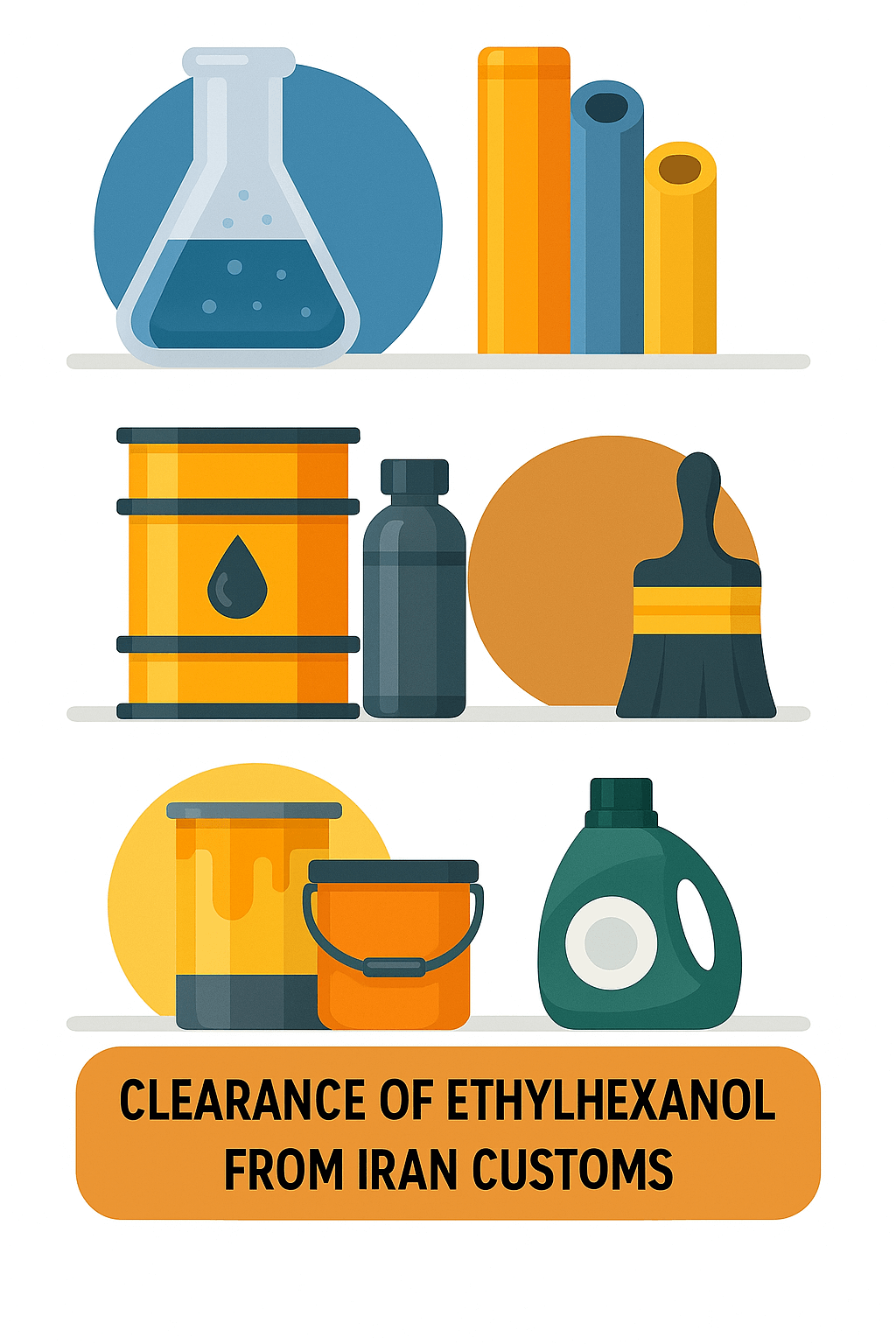
Plastics manufacturing: Ethylhexanol is a key component in producing plasticizers for polyvinyl chloride (PVC). These plasticizers increase flexibility, reduce brittleness, and improve the durability of plastic products, which is useful in manufacturing items such as pipes, coatings, and plastic films.
Lubricants and fuel additives: Ethylhexanol is used in producing industrial lubricants and fuel additives. In this context, it helps improve the physical and chemical properties of fuels. In industrial oils, improved tackiness and prevention of oxidation are among the main benefits of using ethylhexanol.
Paints and coatings industries: This substance is used as a slow-evaporating solvent in the paint and coatings industry. Ethylhexanol helps improve the structure and strength of coatings and increases the service life of industrial paints.
Emulsifier and foaming agent: Another important application of ethylhexanol is in detergents and hygiene products. As an emulsifier, it plays a key role in producing foaming formulations and improves the stability and performance of detergents.
2) Ethylhexanol Customs Tariff (HS Code)
1. Customs Tariff Code (HS Code): Ethylhexanol is classified under tariff code 290519. This code serves as the primary reference for determining customs duties and for applying import-related regulations. Accuracy in selecting the correct tariff code is highly important, as it can directly impact customs costs and the required permits.
| Goods | Short Description | HS Code |
|---|---|---|
| Ethylhexanol (2-ethylhexanol) | Industrial fatty alcohol; solvent/plasticizer/fuel additive | 290519 |
The final line depends on grade, purity, physical state, packaging, and declared application.
3) Key Points in Clearing Ethylhexanol from Customs
4) Steps for Clearing Ethylhexanol from Customs
- The steps for clearing ethylhexanol from customs must be done carefully and in order:
Goods declaration in the EPL system: The first step in the clearance process is registering the customs declaration in the EPL system. At this stage, the goods information—including the tariff code and exact quantity—must be entered correctly. Any error or mistake here can lead to delays in the clearance process.
Document review and assessment by customs: After submitting the declaration, customs experts review the submitted documents. If the documents are complete and flawless, the assessment proceeds quickly. If there are deficiencies or discrepancies, a request for correction or submission of supplementary documents may be made.
Payment of customs duties and taxes: After approval of the declaration and documents, calculations for duties and taxes are made, and the importer must pay the specified amounts. Timely payment is one of the key factors in expediting clearance.
Release of goods and obtaining the customs exit permit: After payment and final approval of documents, the clearance permit is issued and the imported shipment is ready to leave customs.
5) Import/Export and the Market Situation in Iran
6) Import and Export Volumes of Ethylhexanol into Iran
7) Global Circulation of Ethylhexanol and Key Players
8) Major Exporters and Importers of Ethylhexanol
Global importers: Countries such as India, Turkey, and Western European nations are among the largest importers of ethylhexanol. Given their domestic industrial needs, these countries import large volumes. The United States is also one of the largest importers of ethylhexanol, using it mainly for industrial and chemical purposes.
9) Required Documents for Clearing Ethylhexanol from Customs
1. Commercial Invoice
The commercial invoice is the primary document that must be presented to customs. It includes precise information about the goods such as:
Name and specifications of the goods (ethylhexanol)
Quantity (weight or volume)
Unit price and total price
Payment and sales terms
This document helps customs calculate the customs value and verify other documents. The invoice must be completely clear and accurate to avoid issues later in the process.
2. Packing List
The packing list contains details on how the goods are packed. It includes items such as the number of packages, weight of each package, type of packaging, and dimensions. The purpose is to provide an accurate picture of the goods at the time of dispatch to prevent any mistakes during clearance.
3. Certificate of Origin
The certificate of origin identifies the producing country of ethylhexanol. It is issued by the chamber of commerce in the country of origin and is used to calculate customs tariffs. Some countries offer preferential tariffs depending on origin, and this certificate is necessary to apply them.
4. Customs Declaration
The customs declaration is the document in which all information about the goods must be entered. This includes the HS Code, exact quantity, price, and technical specifications. The HS code for ethylhexanol is usually 290519 and must be correctly recorded in the declaration.
5. Material Safety Data Sheet (MSDS)
The Material Safety Data Sheet provides detailed information on the chemical and physical properties of ethylhexanol, safety guidance for handling and storage, and potential hazards. Providing this sheet is essential for compliance with safety and environmental standards.
6. Health and Environmental Permits
Since ethylhexanol is a chemical with environmental sensitivities, you may need health and environmental permits from relevant organizations such as the Department of Environment or the Ministry of Health. These permits ensure that importing this substance does not pose risks to the environment or public health.
7. Inspection Certificate
In some cases, customs may request an inspection certificate. Issued by reputable inspection companies, it confirms the accuracy of technical specifications, quality, and quantity of the goods.
8. Bill of Lading
Issued by the carrier, the bill of lading includes information about the mode of shipment, the consignor and consignee, and detailed specifications of the cargo. It is necessary to prove ownership and to track the cargo during transport.
9. Insurance Certificate
The insurance certificate indicates the cargo’s insurance coverage during transport. It ensures that, in case of incidents during transit, financial losses will be covered. Providing this document is essential to protect the shipment.
Need precise HS determination and health/environment/standards permits? Our team manages the entire case end-to-end.
Submit Proforma Request
Frequently Asked Questions
What is the HS Code for ethylhexanol?
Based on the text: Ethylhexanol is declared under code 290519; the final line depends on technical specifications and application.
What documents are required for clearance?
As per the text: Proforma/commercial invoice, packing list, certificate of origin, customs declaration, MSDS, health/environmental permits, inspection certificate (if requested), bill of lading, and insurance certificate.
Under which regulations is ethylhexanol transported?
Due to its chemical and safety characteristics, transport must follow standard packaging/labeling and international regulations for transporting hazardous chemicals (as applicable ADR/IMDG/IATA).
Special Services for Ethylhexanol Clearance by Saba Brokerage
In the ethylhexanol clearance process, choosing a professional broker can make a major difference. Drawing on experience and expertise in clearing chemical goods, this brokerage provides comprehensive services to ensure all import and clearance stages are carried out quickly and accurately. Some standout services include the following:
- Pre-import expert consulting: Experienced specialists provide necessary advice on documents, tariffs, and import regulations by closely reviewing importers’ needs. This consulting facilitates the import process and prevents potential issues.
- Facilitating permit acquisition: One of the most important aspects of clearing chemicals is obtaining health and environmental permits. With effective ties to relevant organizations, all required permits are obtained more quickly.
- Customs declaration and fast clearance: Extensive experience in preparing and filing customs declarations helps accelerate clearance. All clearance stages are tracked in real time via the EPL system to avoid any delays in workflow.
- Transport and warehousing: In addition to clearance services, necessary coordination for international and domestic transport is also handled. Warehousing of imported goods is carried out within safety and hygiene standards.
- Cost reduction: By using optimized methods and effective interactions with customs authorities, customs costs are reduced and clearance is finalized in the shortest possible time.
