.png)
Customs Clearance of Hydraulic Turbines in Iran (HS Code + Documents and Permits)
For estimating the time and cost of hydraulic turbine customs clearance, get in touch with Saba Tarekhis experts.
Instant Free Consultation1) Types of Hydraulic Turbines
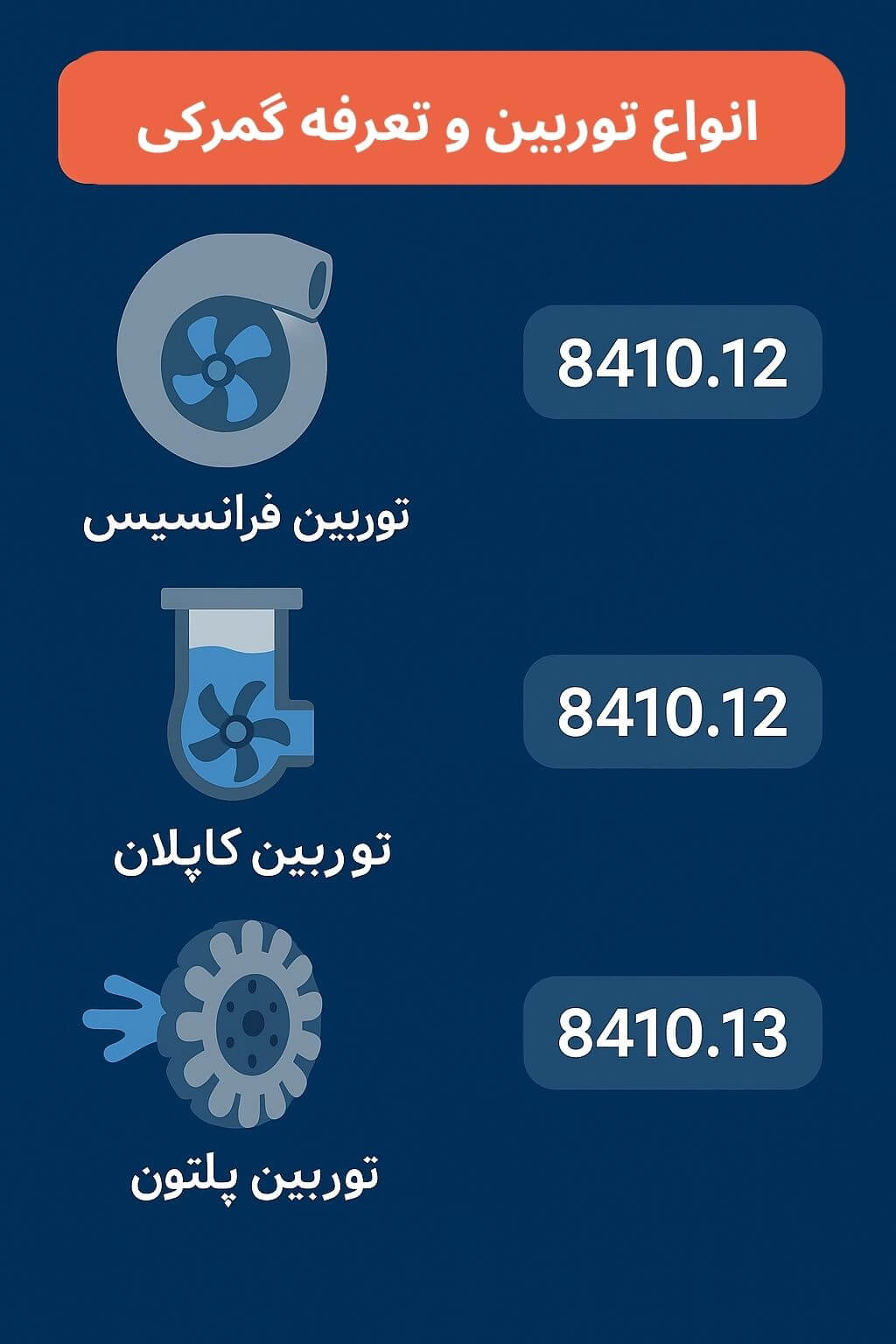
1. Francis Turbine
The Francis turbine is recognized as one of the most widely used hydraulic turbines globally. This reaction turbine is designed for conditions with a Moderate Flow Rate and Medium Head. Its structure allows water to enter the turbine casing through a spiral (scroll) inlet and, by passing between the moving blades, convert its kinetic energy into mechanical energy.
A unique feature of this turbine is its operational flexibility; it can operate efficiently over a wide range of hydrological conditions. For this reason, the Francis turbine is employed in hydropower plants with varying hydrological conditions, including plants where seasonal changes or flow fluctuations are observed.
2. Kaplan Turbine
The Kaplan turbine is also a reaction turbine, but it is specifically designed for High Flow Rate and Low to Medium Head conditions. In this turbine type, the runner blades can adjust their pitch, enabling the Kaplan turbine to achieve maximum efficiency under variable water flow conditions.
This turbine is commonly used in large run-of-river hydropower plants where the water volume is high and the velocity is low. Thanks to its special design that allows blade angle adjustment, the Kaplan turbine can effectively respond to changes in flow rate and maintain high efficiency under different conditions.
3. Pelton Turbine
The Pelton turbine, known as an impulse turbine, is designed for High Head and Low Flow Rate conditions. These turbines are designed so that water, at very high speed, strikes bucket-shaped runner blades in narrow jets and converts its energy into mechanical motion.
Due to its specific design, the Pelton turbine is used in power plants that harness very high heads with low flow rates. These turbines are typically installed in mountainous regions or locations where high head sources with limited water flow exist.
2) Customs Tariff and HS Code
The customs tariff rate for these turbines, depending on their type and characteristics, is generally considered between ۵ to ۱۰ percent of the value of the goods. This rate may change based on international trade agreements, domestic economic policies, and the type of commercial contract. In addition, customs tariffs may include Value Added Tax (VAT), import duties, and other fees that importers need to take into account.
| Item | HS Code | Description |
|---|---|---|
| Francis hydraulic turbine | 8410.12 | Large turbines for medium flow rates |
| Kaplan hydraulic turbine | 8410.12 | Reaction turbines for high flow rates |
| Pelton hydraulic turbine | 8410.13 | Impulse turbines for high heads |
3) Customs Clearance Process for Hydraulic Turbines
- Customs clearance of hydraulic turbines is a complex and sensitive process that requires specialized knowledge of customs regulations, international standards, and the import conditions for this equipment. The clearance process includes multiple stages, each of which requires care and special attention to avoid delays and additional costs.
1. Order Registration and Obtaining Permits
The first step in the clearance process for hydraulic turbines is Order Registration in relevant systems such as Iran’s Comprehensive Trade System. This stage involves submitting initial documents and the technical specifications of the goods to the competent authorities such as the Ministry of Energy, the National Standards Organization, and the Department of Environment. These organizations must issue the necessary import permits, which include environmental permits, safety approvals, and technical standards.
2. Preparing and Submitting the Required Documents
In the next stage, the precise preparation and completion of commercial and customs documents is essential. These include:
Commercial Invoice: containing full details of the goods, price, and terms of sale.
Packing List: this list must accurately include the dimensions, weight, quantity, and packaging type of each part of the turbine.
Bill of Lading: a document issued by the carrier that specifies the transport information and delivery terms of the goods.
Certificate of Origin: this certificate indicates the manufacturing country of the turbine and is very important for determining the customs tariff.
These documents must be prepared with complete accuracy and submitted to customs so that the clearance process proceeds without issues.
3. Technical Inspection and Evaluation of the Goods
After submitting the documents, customs experts conduct a technical review of the hydraulic turbines. This review includes assessing the real value of the goods, matching the technical specifications with the submitted documents, and ensuring compliance with all relevant standards. At this stage, physical inspection of the goods may also be conducted to ensure they conform to the specifications declared in the documents.
4. Payment of Customs Duties and Taxes
After the final assessment, the amount of customs duties and taxes is calculated by customs. This amount includes customs tariffs, taxes, and other charges that must be paid before the goods are released. This is a critical stage, because until these costs are fully paid, the turbines cannot be cleared and may incur fines or additional charges.
5. Release and Transport to the Final Destination
Upon completion of all stages and payment of the required costs, the customs release permit is issued. At this point, the hydraulic turbines are released from customs and transported to the final destination. Depending on the contract conditions, this may include delivery to the project site, the customer’s warehouse, or other designated locations. Coordination with transportation companies and the insurer is also of particular importance at this stage to ensure the goods reach their destination safely and promptly.
Need to accelerate the hydraulic turbine clearance process? Our team manages the case end-to-end.
Request a Proforma Invoice
Frequently Asked Questions
What is the HS Code for a hydraulic turbine?
Depending on the type, turbines are classified under 8410.12 (reaction) and 8410.13 (impulse).
What documents are required for clearance?
Purchase invoice, packing list, bill of lading, certificate of origin, and permits from the Ministry of Energy and the Department of Environment.
Special Customs Clearance Services by Saba Brokerage
With years of experience in clearing complex and sensitive goods—especially industrial equipment such as hydraulic turbines our team is among the top providers of customs services in Iran. Our services include:
Specialized pre-import consulting: providing expert advice to importers for selecting reputable suppliers and ensuring compliance with international standards. These services help you make the best decisions in the early stages of import.
Obtaining necessary permits: with extensive experience in quickly and reliably obtaining all required permits from various bodies, our team makes the import process simpler and more cost-effective for clients. These permits include environmental approvals, technical standards, and other essential authorizations.
Preparing and submitting customs documents: our experts, fully familiar with customs laws and regulations, prepare all required documents with precision and submit them to customs. This attention to detail prevents issues during the clearance stages.
Fast and trouble-free clearance: leveraging numerous experiences in hydraulic turbine clearance, we can expedite the process and reduce import costs. This competitive advantage helps our clients advance their projects without delays and with cost savings.
Transport and delivery at destination: after clearance, we provide transport and delivery services to the final destination with the highest safety standards and in the shortest possible time. These services include coordination with international carriers and precise management of goods transportation.
Our brokerage, committed to delivering high-quality, specialized services, strives to make the hydraulic turbine clearance process simple and hassle-free for our clients. With us, you can be confident your goods will reach the final destination in the best condition and in the shortest possible time.
