.png)
Customs Clearance of Ethylene and Propylene | HS Code, Documents, Safety, and Methods

To estimate the time and cost of clearing ethylene and propylene, contact the Saba Tarkhis experts.
Fast & Free Consultation1) Detailed Description of Ethylene & Propylene and Clearance Features
- Full inclusion of technical characteristics, hazard class, and UN number (where applicable) in transport documents.
- Ensuring tank/container labeling complies with dangerous goods transport standards.
- Advance coordination for potential sampling and quality/safety checks.
2) Types and Applications
Applications of Ethylene
- Production of polyethylene: the main material for various plastics (bags, bottles, pipes).
- Agriculture: as a plant hormone to accelerate fruit ripening and improve post-harvest management.
- Production of ethylene glycol: used in antifreeze and polyester production.
Applications of Propylene
- Production of polypropylene: widely used in packaging, auto parts, and fibers.
- Production of propylene oxide: feedstock for polyurethanes and glycols.
- Intermediate chemicals: acrylonitrile, isopropyl alcohol, and acrylic acid for a wide range of industries.
3) Key Steps and Considerations in Clearance
Order Registration and FX Management
Permit Coordination and Controls
- Coordination with competent energy/petrochemical authorities for specialized permits (if required).
- Compliance with dangerous goods safety and packaging standards per domestic and international regulations.
4) Customs Tariff / HS Code
| Product | Short Description | HS Code |
|---|---|---|
| Ethylene | Alkene gas, core petrochemical feedstock | 29012100 |
| Propylene | Alkene gas, core petrochemical feedstock | 29012200 |
Any misdeclaration of HS can cause delays, valuation disputes, and penalties.
5) Special Conditions for Import and Export
- Compliance with safety, labeling, and dangerous goods transport standards.
- Preparedness for sampling, certificate of analysis, and quality checks at the border.
- Coordination with specialized bodies for necessary permits, especially during sensitive periods.
6) Iran Market: Imports and Exports
7) Taxes & Duties; Trade Volume
8) Global Market: Major Exporters and Importers
9) Required Documents for Clearance
- Commercial Invoice with full details of price, quantity, total value, payment terms, and party information.
- Packing List including count, type, weight/dimensions of packages, and packing method.
- Certificate of Origin issued by a competent body at origin and consular attestation if required.
- Certificate of Analysis covering chemical composition, purity, and physical properties.
- Special permits (if required) from relevant energy/petrochemical authorities for safety and quality control.
- Transport documents (Bill of Lading), insurance policy, and any safety documents related to dangerous goods carriage.
10) Fast Clearance Method in Iran + Special Services
- Accurate HS Code determination (29012100 for ethylene, 29012200 for propylene) aligned with technical documents.
- Order registration and FX arrangements; check periodic restrictions/priorities.
- Document completion: invoice, packing list, B/L, CO, certificate of analysis, specialized permits (if needed).
- Customs declaration including technical specs, hazard class, weight/volume, and transport details.
- Assessment and payment of duties and charges based on CIF value.
- Respond to possible inspection/sampling; comply with yard safety requirements.
- Final release and delivery to destination with a safety-qualified fleet.
Safety, Storage, and Transport (ADR/IMDG)
- Controlled temperature: transport as pressurized liquid at low temperatures to prevent boil-off and leakage; use cryogenic tanks and monitoring systems.
- Safety standards: leak detectors, relief valves, pressure/temperature control, proper labeling, and fire-fighting equipment.
- Training & equipment: staff training, PPE, and emergency response procedures.
- International regulations: compliance with ADR (European road) and IMDG (maritime) based on dangerous goods classification.
Key Points and Practical Tips
- Keep all technical specs (purity/impurities/hazard class) consistent between the COA and the declaration.
- Maintain cold/pressure chain during transport and retain data-logging reports.
- Pre-arranged sampling and testing speed up clearance.
- Base all work on the correct HS Code to avoid valuation disputes and penalties.
| Product | Key Application | Safety Sensitivities | HS |
|---|---|---|---|
| Ethylene | Polyethylene, ethylene oxide/glycol | Highly flammable; requires temperature/pressure control | 29012100 |
| Propylene | Polypropylene, propylene oxide | Highly flammable; ADR/IMDG requirements | 29012200 |
Need a specialized hazardous materials clearance plan? Our team manages the case end-to-end.
Submit a Proforma Request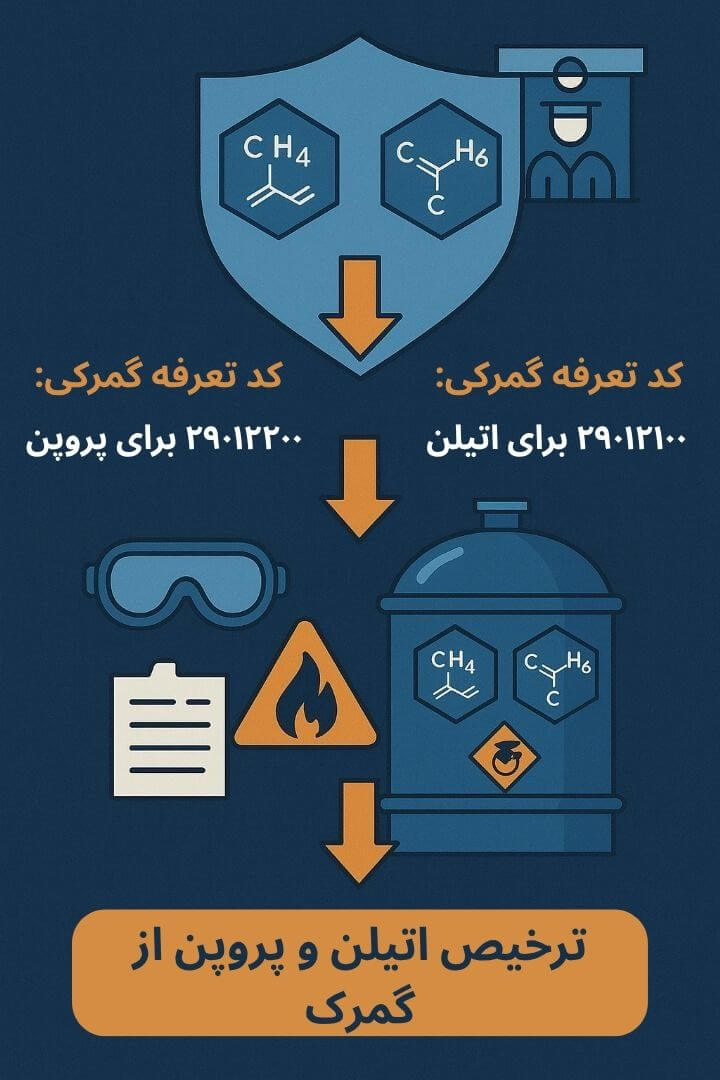
Frequently Asked Questions
What are the HS Codes for ethylene and propylene?
Ethylene: 29012100 and Propylene: 29012200. These codes must be stated precisely in import documentation.
What documents are required for clearance?
Invoice, packing list, certificate of origin, certificate of analysis, specialized permits (if required), transport documents, and insurance.
What are the safety requirements for transporting these materials?
Transport as pressurized liquids, temperature/pressure control, anti-leak safety equipment, and compliance with ADR/IMDG regulations.
How are import duties and VAT calculated?
They are calculated on a CIF basis, and the percentages depend on the tariff line and current policies.
Special Customs-Clearance Services by Saba Brokerage
As a trusted customs brokerage, Saba provides dedicated services for petrochemical cases, including classification & HS advisory, order registration, obtaining specialized permits, document management, professional declaration, and sampling coordination through delivery.
Benefits of working with Saba Tarkhis:
- Lower risk of delays and demurrage via precise document and timeline management.
- Faster processing through close coordination with authorities and compliance with HSE requirements.
- Choosing suitable tanks and transport (cryogenic tank/ISO tank) per standards.
