.png)
Customs Clearance of Electronic Circuit Manufacturing Machines from Iranian Customs (HS Code + Documents & Permits)
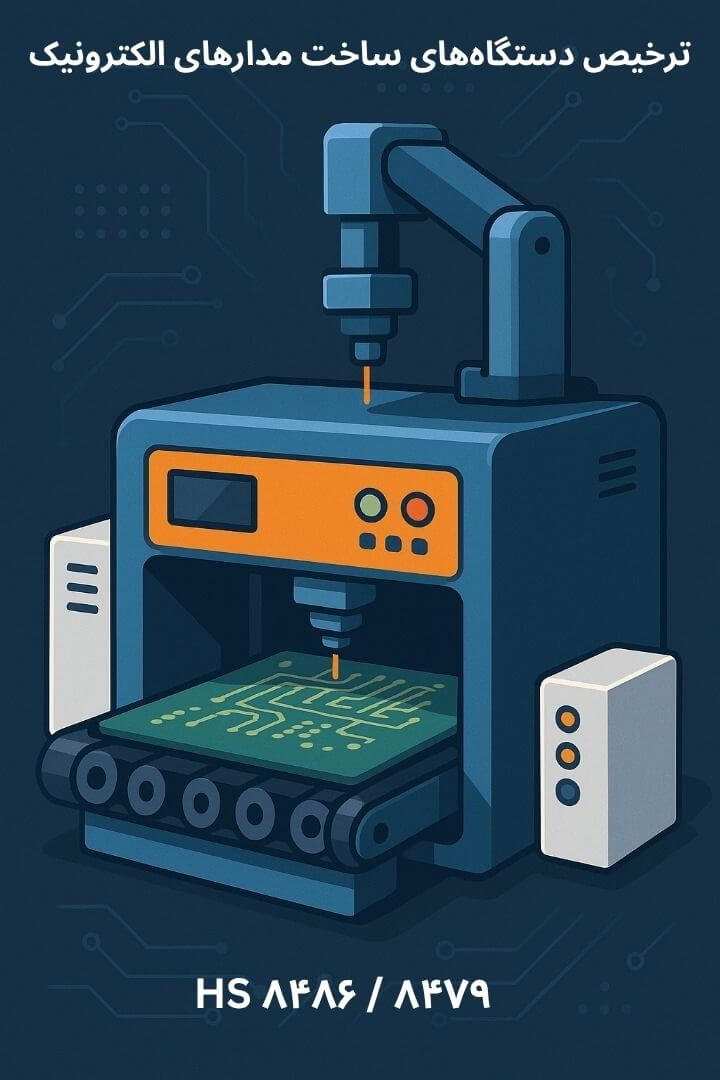
To estimate the time and cost of clearing electronic circuit manufacturing machines, get in touch with the experts at Saba Tarkhis.
Instant & Free Consultation1) Types of Electronic Circuit Manufacturing Machines
Printed Circuit Board (PCB) Printers
Automatic Soldering Machines
Precision Drilling Machines
Testing and Quality Assurance Equipment
2) Key Points in Clearing Electronic Circuit Manufacturing Machines from Customs
1. Customs Tariff Code (HS Code)
- Code 8486: This code is dedicated to machines and equipment for manufacturing semiconductors and integrated circuits (such as lithography equipment, semiconductor assembly machines, and other related equipment).
- Code 8479: This code covers miscellaneous industrial machinery and devices used in production and assembly processes of electronic circuits.
2. Required Documents for Clearance
- Proforma Invoice: This document includes precise information about the goods, price, payment terms, and shipping conditions.
- Packing List: This document provides full packaging specifications and the contents of the shipment.
- Certificate of Origin: This certificate determines the country of manufacture and can directly affect the import tariff rates in some cases.
- Standard and Quality Certificates: Includes certifications such as CE, ISO, and UL, indicating compliance with international standards. These certificates are mandatory for some machines and equipment, and without them, clearance may not be possible.
- Special import permits for specific equipment: For importing certain electronic circuit manufacturing machines, special permits from organizations related to the electronics industry or the Atomic Energy Organization may be required.
3. Compliance with Technical Regulations and Standards
4. Customs Assessment and Inspection
5. Payment of Duties and Customs Charges
6. Transportation and Delivery of Goods
3) Sample Tariff Codes (HS Codes) for Circuit-Manufacturing Machines
| Item/Subgroup | Short Description | HS Code (Example) |
|---|---|---|
| Semiconductor/Integrated Circuit manufacturing equipment (lithography, assembly, etc.) | Special-purpose machinery for IC and semiconductor production | 8486 |
| Miscellaneous industrial machinery related to board production/assembly | Auxiliary processes for electronic circuit manufacturing | 8479 |
The exact classification depends on the type of machine, application, technical specifications, accessories, and manufacturer’s documentation.
4) Customs Valuation
5) Import and Export of Electronic Circuit Manufacturing Machines
6) Global Market for Electronic Circuit Manufacturing Machines
7) Required Documents for Clearance
-
Proforma Invoice
The proforma invoice includes detailed specifications of electronic circuit manufacturing machines, quantity, unit price, total price, payment terms, and other purchase-related information. This document is provided by the seller to the buyer and serves as a pre-invoice or preliminary purchase contract. -
Commercial Invoice
The commercial invoice (main invoice) is issued by the seller after the transaction and includes full details such as product specifications, quantity, price, and payment terms. This document is essential for calculating customs duties and charges. -
Bill of Lading
The bill of lading is a document issued by the carrier that includes shipment details, transport conditions, and information about the consignor and consignee. This document is also recognized as proof of ownership of the goods. -
Packing List
The packing list includes detailed information about the shipment’s packaging, including the number of packages, type of packaging, the weight of each package, and their contents. This list is used to reconcile with the information in the bill of lading and the invoice. -
Certificate of Origin
The certificate of origin is issued by the chamber of commerce in the country of origin and confirms from which country the electronic circuit manufacturing machines have been imported. This document is necessary for applying preferential tariffs and for compliance with trade regulations. -
Standards and Quality Certificates
Includes certificates such as CE, ISO, and UL, which indicate compliance with international standards. These certificates are mandatory for some devices and equipment, and without them, clearance may not be possible. -
Permits Related to the Import of Specific Equipment
For importing some types of electronic circuit manufacturing machines, special permits from organizations related to the electronics industry or the Atomic Energy Organization may be required.
Need precise HS Code determination, permits, and document preparation? Our team manages the case end-to-end.
Submit Proforma RequestFrequently Asked Questions
What is the common HS Code for circuit-manufacturing machines?
Depending on the machine type and application, headings 8486 (semiconductor/IC manufacturing equipment) and 8479 (miscellaneous industrial machinery) are frequent. Final determination is made using the catalog and technical documents.
What documents are required for clearance?
Proforma, commercial invoice, packing list, bill of lading, certificate of origin, CE/ISO/UL certificates, and special permits (if needed) are the main requirements.
How is customs valuation carried out?
Based on the commercial invoice price and supporting documents; physical inspection/sampling is performed if needed, and a revaluation may occur.
Special Clearance Services by Saba Brokerage
Specialized services for clearing electronic circuit manufacturing machines include a set of professional and comprehensive actions that help importers successfully carry out the import of this advanced equipment in the shortest possible time. These services are provided as follows:
Specialized pre-import consulting: With precise guidance in the correct selection of customs tariff codes, preparing the required documents, and accurate value assessment, our experienced expert team helps importers take the right steps from the very beginning of the import process and prevent potential issues during clearance.
Facilitation in obtaining permits: By leveraging experience and extensive connections with government bodies, the process of obtaining special permits for importing sensitive and advanced equipment is carried out quickly and efficiently to ensure that all legal requirements are properly met.
Follow-up and expediting the clearance process: The operations team manages the clearance process by continuously following up on the files, preparing and submitting the required documents, accurate valuation, and conducting necessary inspections, so that there is minimal delay in delivering the goods to the importer.
Post-clearance services: In addition to the clearance process itself, post-clearance support and consultation are also provided to importers to ensure that all legal and administrative stages have been properly completed and that the goods are delivered to the importer without any issues.
By utilizing these comprehensive and professional services, importers can be confident that the clearance of electronic circuit manufacturing machines will be carried out in the best possible manner, minimizing unnecessary costs and delays. These services provide assurance for a successful and trouble-free import of advanced electronic equipment into Iran.
