.png)
Cork Clearance from Iran Customs (HS Code + Documents & Permits)
To estimate the time and cost of cork clearance (Cork), contact the experts at Saba Tarkhis.
Instant free consultation1) Cork Properties and Its Applications
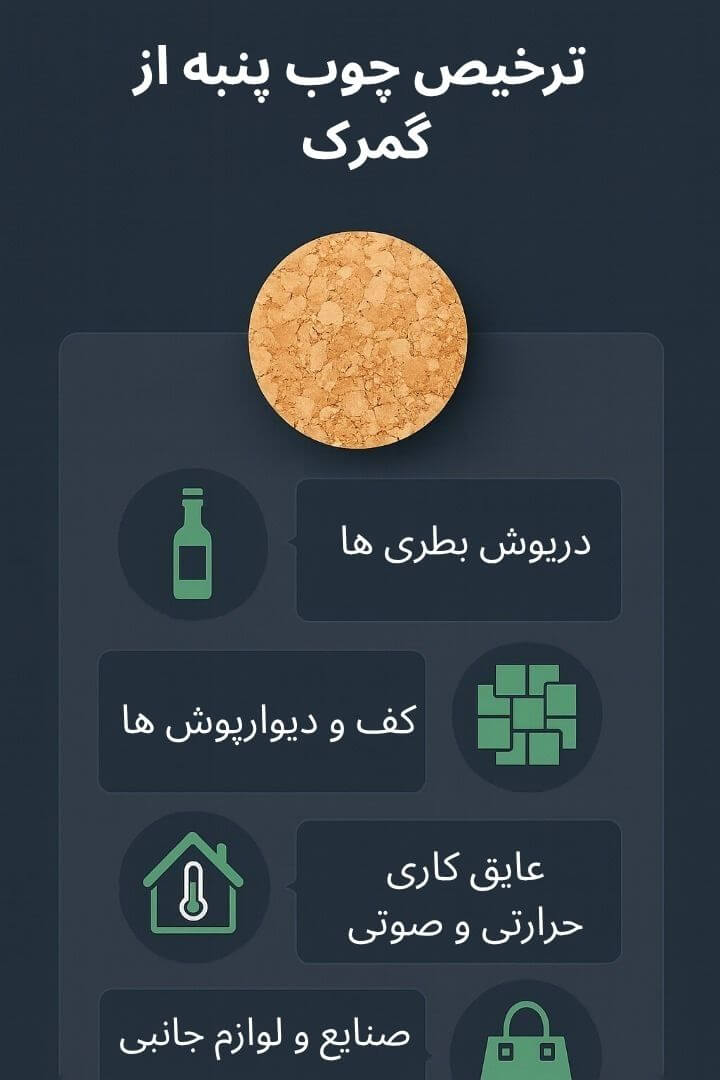
Production of bottle stoppers: One of the most common and important uses of cork is as stoppers for beverage bottles, especially wine bottles. Due to its cellular structure, cork prevents air exchange and preserves beverage quality. Thanks to its high elasticity, it returns to its original shape after compression, making it ideal as a stopper.
Flooring and wall coverings: As a natural thermal and acoustic insulator, cork is used to produce flooring and wall coverings—highly valued in construction. Cork floors, thanks to their softness and abrasion resistance, are an ideal choice for residential and commercial settings.
Thermal and acoustic insulation: Cork is used as a natural thermal and sound insulator in construction, especially in green building projects. Owing to its microscopic structure, it effectively reduces heat and sound transfer, making it an excellent choice for insulation systems.
Fashion and accessories industries: As a natural and sustainable material, cork is also popular in fashion and accessory design. It is used to make bags, shoes, belts, and other fashion items. Its light weight, high durability, and environmental compatibility make it a leading option for ecofriendly products.
2) Cork HS Code and Clearance Notes
3) Cork Import and Export Conditions
Conditions for importing cork into Iran
Conditions for exporting cork from Iran
4) Cork Import/Export Volumes for Iran
5) Global Cork Turnover
6) Major Global Cork Exporters and Importers
Leading cork exporters
- Portugal: the world’s largest producer and exporter of cork.
- Spain: the second-largest cork producer globally.
- Italy: another European country active in cork production and exports.
- Morocco: also a producer engaged in cork exports.
Leading cork importers
- United States: the largest importer of cork due to high demand in the beverage industry and bottle stopper production.
- Turkey: a major importer for beverage and packaging industries.
- India: a growing market, especially for insulation and packaging industries.
- Germany and France: due to extensive use in construction and beverages, they are key cork importers in Europe.
| Goods | Short description | HS Code |
|---|---|---|
| Cork | Raw/processed and by-products | 4501 |
The exact subheading depends on type (raw/processed), processing, form of supply, and end use. For some items, obtaining a phytosanitary certificate is mandatory.
7) Required Documents for Cork Clearance from Customs
-
Commercial Invoice
One of the most important documents in clearance. It includes details such as buyer and seller, product type and quantity, total price, and payment terms—effectively stating what was purchased and for how much. -
Certificate of Origin
Shows the country from which the cork was exported. Usually issued by the chamber of commerce in the country of origin and plays a key role in determining customs tariffs and leveraging international trade preferences. -
Phytosanitary Certificate
Because cork is natural, pest and plant disease entry must be prevented. This certificate confirms the imported cork is free from pests/diseases and is issued by the sanitary authorities of the exporting country. -
Packing List
Shows how the goods are packed and includes details such as number of packages, net and gross weight, and package dimensions. This helps customs verify the shipment against other documents. -
Bill of Lading
Issued by the carrier, confirming the goods have been properly loaded and are in transit. Includes transport method, destination, and transport terms. -
Import License
In certain cases, importing cork requires an import license. It indicates the importer is authorized to import the specified goods; customs may deny entry without it. -
Customs Declaration
Prepared by the importer or customs representative and includes detailed information on the goods, customs value, tariff, and shipment specifications. It enables proper assessment and clearance. -
Inspection Certificate
Depending on the exporting country and cork type, pre-import inspection may be required. This certificate shows the goods meet quality and specified standards.
Need to determine 4501 subheadings, obtain a phytosanitary certificate, and prepare documents? Our team manages the case end to end.
Submit a proforma request
Frequently Asked Questions
What is the HS Code for cork?
Cork falls under Chapter 45 and is mainly classified under heading 4501; the exact subheading depends on whether it is raw/processed and on the form supplied.
Is a phytosanitary certificate required?
Yes. To prevent transmission of plant pests/diseases, obtaining a Phytosanitary Certificate from the country of origin is usually mandatory.
What documents are needed for clearance?
As listed: commercial invoice, certificate of origin, phytosanitary certificate, packing list, bill of lading, import license, customs declaration, and inspection certificate.
Special Customs Services for Cork Imports and Exports
With years of experience in customs clearance, one of the leading companies in this field offers specialized services for cork imports and exports. With a team of seasoned experts fully familiar with domestic and international customs rules, the company has effectively optimized the clearance process and helped importers and exporters streamline procedures.
Specialized consulting: Advising on selecting optimal tariff headings and reducing costs especially for cork imports.
Document preparation and completion: The professional team prepares all required papers, including phytosanitary certificates, certificates of origin, and commercial invoices, completely and accurately.
Fast and effective follow-up: Tracking clearance steps and coordinating with customs authorities to prevent potential delays.
Reducing costs and clearance time: Leveraging extensive relationships with customs, the company can complete clearance in the shortest possible time with optimized costs.
With these specialized services, this company is a suitable option for those seeking fast, trouble-free clearance.
