.png)
Customs Clearance of Alcohols and Halogenated Derivatives from Iranian Customs (HS Code + Permits and Standards)
Clearance of Alcohols and Halogenated Derivatives
Alcohols and halogenated derivatives are recognized as some of the main chemical materials in various industries, including pharmaceuticals, cosmetics, healthcare, chemical, and food. Owing to their specific chemical properties, these materials play an important role in production and research processes. Clearing these categories of goods from customs requires deep and specialized knowledge to successfully pass related legal and health stages.
Alcohols are chemical compounds that include one or more hydroxyl groups (-OH) attached to a carbon atom. Due to their high solubility in water and the ability to form hydrogen bonds, they are used as effective solvents in many industrial processes. Halogenated derivatives of alcohols are compounds in which hydrogen atoms are replaced by halogen atoms (fluorine, chlorine, bromine, or iodine). These changes lead to compounds with different physical and chemical properties that have wide applications across various industries.
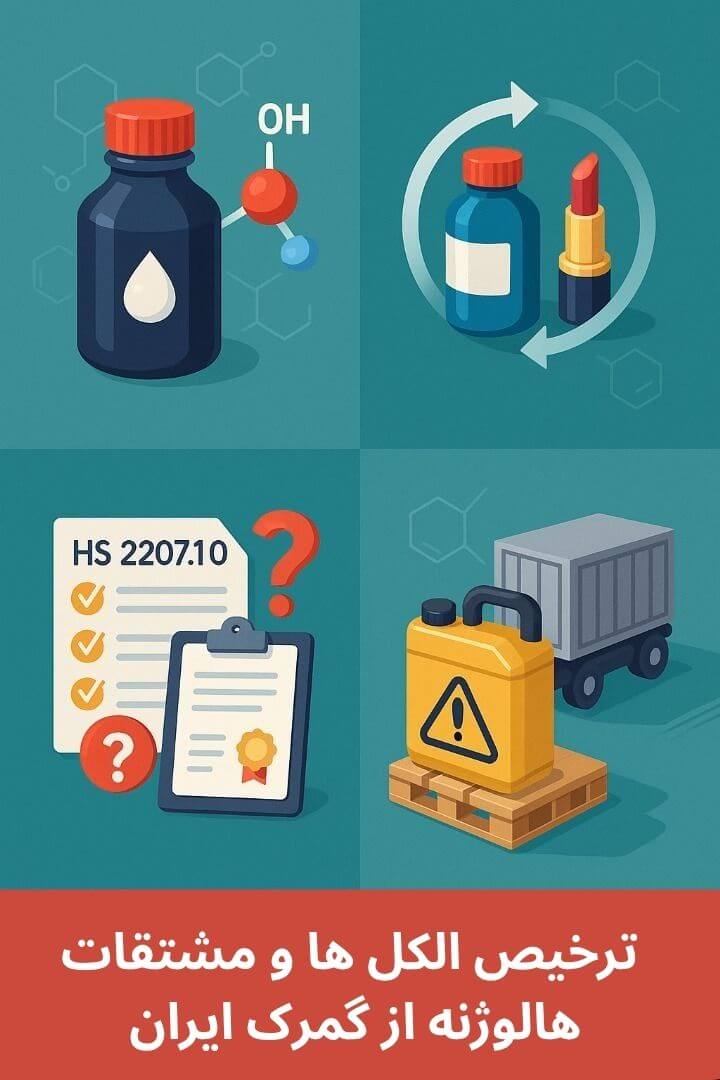
For estimating time and cost of clearing alcohols and halogenated derivatives, contact the experts at Saba Customs.
Immediate and Free ConsultationApplications of Alcohols and Halogenated Derivatives
Pharmaceutical industries: Alcohols are used as solvents in drug preparation and also as disinfectants. Halogenated derivatives are used in the production of specific medicines.
Cosmetics and healthcare industries: Due to their solvency and rapid evaporation, alcohols are widely used in cosmetic and healthcare products. Halogenated derivatives are also used as preservatives and disinfectants in this industry.
Chemical industries: Alcohols and halogenated derivatives are used as solvents and chemical intermediates in the production of various complex chemicals.
Food industry: Some types of alcohols are used as food additives and preservatives, although these applications are strictly regulated by health authorities.
Paint and resin manufacturing: Alcohols and halogenated derivatives are used as solvents and chemical intermediates in the production of paints and resins.
Specialized Notes for Clearing Alcohols and Halogenated Derivatives from Customs
1. Customs Tariff (HS Code)
Accurate and correct selection of the customs tariff for alcohols and halogenated derivatives is one of the most important stages in the process of clearing these goods. The customs tariff directly affects import costs and clearance time. Some important tariff codes in this area include:
Industrial alcohols (HS Code 2207.10.10): This tariff code relates to industrial alcohols such as methanol, industrial ethanol, and other non-potable alcohols that are mainly used in chemical and manufacturing industries.
Ethanol (HS Code 2207.10.90): This tariff code includes potable ethanol or ethanol for specific uses such as in pharmaceutical and cosmetic industries. Due to its various applications and public health sensitivities, this code may be subject to increased oversight.
Halogenated derivatives: For halogenated derivatives of alcohols, determining the tariff code depends on the exact chemical composition, the type of halogen (such as chlorine, bromine, fluorine, or iodine), and the degree of halogen substitution in the molecule. Incorrect selection of the tariff code can lead to legal and tax issues; therefore, careful review and consultation with an experienced customs broker is necessary.
| Product Group | Description | HS Code (Example) |
|---|---|---|
| Industrial Alcohols | Methanol/industrial and non-potable ethanol | 2207.10.10 |
| Ethanol for specific uses | Pharmaceutical/cosmetic/potable | 2207.10.90 |
| Halogenated derivatives of alcohols | Depends on halogen type/substitution | — (case-by-case) |
Final determination depends on composition, purity, use, and technical documents (COA/SDS).
2. Health and Organizational Permits
Importing alcohols and halogenated derivatives—due to their specific chemical properties and their potential impact on human health and the environment—requires obtaining various permits from relevant organizations. Some of these permits include:
Food and Drug Administration (FDA): For importing chemicals used in manufacturing medicines, healthcare products, and food items, obtaining a permit from the Food and Drug Administration is mandatory. This organization typically evaluates product quality and safety and may require more detailed qualitative and quantitative testing.
Atomic Energy Organization: If halogenated derivatives include radioactive elements or substances with potential environmental risks, obtaining approval from the Atomic Energy Organization is necessary. This approval includes assessment of risks related to the use and storage of the materials.
Environmental Organization: Some halogenated derivatives, due to potential environmental effects (such as ozone depletion or generation of toxic pollution), are under strict oversight by the Environmental Organization. This organization may impose specific conditions for importing and using these materials.
3. International and National Standards
Compliance with national and international standards for alcohols and halogenated derivatives is not only essential to ensure product quality and safety, but can also influence the speed of customs clearance. Some of these standards include:
ISO standards: The International Organization for Standardization (ISO) has developed a set of standards for chemicals including alcohols and halogenated derivatives. These standards usually pertain to various aspects such as purity, testing methods, packaging, and product labeling.
National standards: In some countries, specific national standards for alcohols and halogenated derivatives exist that may go beyond ISO requirements. In Iran, compliance with national standards is particularly important for consumer products (such as medicines and food items).
4. Transportation Conditions
Due to the intrinsic hazards associated with many halogenated derivatives, observing specific conditions for the transportation of these materials is highly important. Some of these conditions are as follows:
Special packaging: Halogenated derivatives must be transported in safe and resilient packaging that complies with international standards for transporting hazardous materials (such as UN standards). This packaging must be sufficiently resistant to leakage, pressure, and high temperatures.
Proper labeling: Hazardous chemicals must have labels indicating their hazards. These labels should provide accurate information about the type of substance, associated risks, and safety instructions.
Permits for transporting hazardous materials: For transporting halogenated derivatives, obtaining specific permits from responsible organizations (such as the railway administration, civil aviation authority, or maritime transport companies) is necessary. These permits include approvals for the type of vehicle and the transport route.
Import and Export Conditions for Alcohols and Halogenated Derivatives
Import to Iran: These materials are mainly imported from industrial countries such as Germany, China, India, and the United States. These countries, as major producers of chemicals, supply high-quality products to the global market.
Export from Iran: Exports of these materials are made to neighboring countries such as Iraq, Afghanistan, and some Central Asian countries. With high production capacities, Iran is considered one of the important regional suppliers in this field.
Import and export volume:
In recent years, imports of alcohols and halogenated derivatives into Iran have increased significantly due to the growth of the pharmaceutical and cosmetic-health industries in the country. However, economic and political changes may affect this trend. On the other hand, exports of these materials are also increasing due to demand in neighboring markets.
Global Circulation and Market of Alcohols and Halogenated Derivatives
The global market for alcohols and halogenated derivatives is one of the most active chemical markets due to their wide industrial applications. European countries and North America are among the largest producers and exporters of these materials, while Asian and African countries are among the largest importers.
Need precise HS and a clearance plan? Our team manages the case end to end.
Submit a Proforma Invoice Request
Frequently Asked Questions
What is the common HS Code for alcohols?
As noted in the text: industrial alcohols 2207.10.10 and ethanol for specific uses 2207.10.90. For halogenated derivatives, the heading depends on composition and the type of halogen.
What permits are required for import?
Permits from the Food and Drug Administration, and if necessary from the Atomic Energy Organization and the Environmental Organization, depending on the nature and use of the material.
What are the safe transport conditions?
Packaging compliant with UN standards, GHS labeling, and obtaining hazardous materials transport permits for the relevant route/vehicle.
What is the trend of import/export markets?
Imports from Germany/China/India/USA are significant; exports to neighboring countries have been increasing and fluctuate under economic/political conditions.
Special Customs Clearance Services by Saba Brokerage
With years of experience in clearing chemical goods, especially alcohols and halogenated derivatives, our team provides comprehensive and professional services to clients. These services include:
Expert consultation: Our specialized team, using up-to-date knowledge of customs and health regulations, provides the necessary advice for correct tariff selection and obtaining related permits for clients.
Obtaining legal permits: With complete mastery over the processes of obtaining health permits and other necessary approvals from relevant organizations, we ensure all legal stages are carried out correctly.
Fast and reliable clearance: Using advanced electronic systems and direct communications with customs, the clearance process is completed in the shortest possible time and with high precision.
Safe transportation: In cooperation with reputable transport companies, safe transportation in accordance with international standards for sensitive chemical goods is guaranteed.
24/7 support: Our support team is ready 24 hours a day to respond to questions and resolve customer issues at all stages of the clearance process.
By choosing our team, entrust the clearance of your alcohols and halogenated derivatives to professionals and benefit from complete and flawless services.
