• Head Office: Unit 502, 5th floor, No. 222, Kashani Ave, Tehran
  • Working Hours: Sat to wed, 8.30 AM - 5 PM (Tehran Time)
  • Phone

    +989121536145

Cyclanic Ethers Customs Clearance | Saba Tarkhis
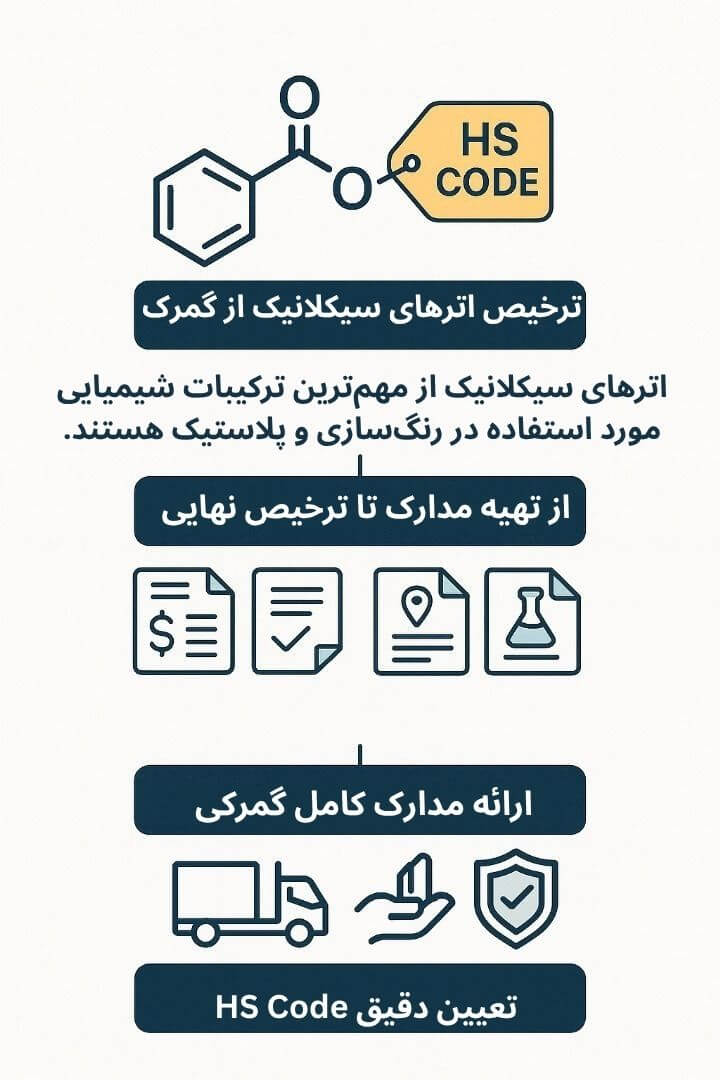
Cyclanic ethers are among the most important and widely used chemical compounds across various industries. The chemical structure of these compounds includes carbon rings bonded to oxygen, granting them unique physical and chemical properties. Owing to their high solvency, chemical stability, and reactivity, these materials are employed in a wide range of industries including pharmaceuticals, petrochemicals, plastics manufacturing, food industry, and paints & coatings.
Explanation of this product’s clearance steps

Contact Saba Tarkhis experts for time and cost estimates of cyclanic ethers clearance.

Instant & Free Consultation

Applications of Cyclanic Ethers

Pharmaceutical industry: Thanks to high reactivity and excellent solvency, cyclanic ethers are used as chemical intermediates in the production of complex drugs and sensitive pharmaceutical compounds. These materials help form specific chemical bonds in next-generation drug synthesis.

Petrochemical industry: In petrochemical processes, cyclanic ethers serve as feedstocks for producing resins, heat- and corrosion-resistant plastics, and even chemical catalysts. They play a key role in manufacturing advanced polymers used in industrial equipment and automotive applications.

Food industry: Certain types of cyclanic ethers are used as safe solvents in food production processes. They are not only safe for use but also help improve quality and shelf life of some food products.

Paints and coatings: Due to their high thermal and chemical stability, these ethers are used to produce coatings resistant to corrosion, heat, and moisture. Such coatings are vital in industries like shipbuilding, automotive, and industrial equipment.

Key Points in Cyclanic Ethers Customs Clearance

Clearing cyclanic ethers is a complex process that requires observing important technical and administrative points. This section details the procedures needed to clear these chemical materials.

Classification and Customs Tariff Code (HS Code)

Due to their specific features, cyclanic ethers are identified in the global customs coding system under tariff code 292090. This code covers ethers and their derivatives. It is crucial that the importer accurately identifies and classifies the goods to avoid coding errors. Mistakes in determining the tariff code can lead to clearance delays, increased costs, and even customs penalties.

Required Documents

  • Commercial Invoice including product details, price, and purchase terms.
  • Bill of Lading covering transport specifications and shipment information.
  • Certificate of Origin confirming the producing country.
  • Technical Data Sheet detailing chemical composition and technical specs of the imported materials. This analysis includes information on solubility, boiling point, and product applications.

Mandatory Licenses

  • License from the Department of Environment to ensure compliance with environmental standards for handling and storage.
    License from the Ministry of Health to ensure no harm to public health if used in food or pharmaceutical industries.
    Food and Drug Organization approval when cyclanic ethers are used in food production.
    Safety and transport standards: Because of their chemical nature, cyclanic ethers require strict safety standards during transport and storage. Proper packaging and the use of standard transport means that prevent leakage or environmental damage are mandatory. Packaging and transport method must also comply with international dangerous goods regulations (IMDG).

Safety and Transport Standards

Because of their chemical nature, cyclanic ethers require strict safety standards during transport and storage. Proper packaging and the use of standard transport means that prevent leakage or environmental damage are mandatory. Packaging and transport method must also comply with international dangerous goods regulations (IMDG).

Special Conditions for Import and Export of Cyclanic Ethers

Import to Iran

Importing cyclanic ethers into Iran is of particular importance due to growing industrial needs, especially in petrochemicals and pharmaceuticals. Most imports come from countries such as China, Germany, the United States, and South Korea. Owing to advanced technologies and know-how in producing chemical compounds, these countries are the main suppliers of cyclanic ethers. Given the high demand in Iran, the volume of cyclanic ether imports has been steadily increasing. According to recent statistics, import volumes have grown significantly in past years, and with further expansion of the chemical industries this trend is expected to continue.

Export from Iran

As one of the key producers of cyclanic ethers in the region, Iran has managed to export these materials to neighboring countries. Exports mainly go to Turkey, the United Arab Emirates, and Iraq. With the development of Iran’s petrochemical industries and the high quality of domestic production, opportunities for exporting these products to global and regional markets are available.

Import and Export Volumes of Cyclanic Ethers

Due to high demand in various industries—especially petrochemicals and pharmaceuticals—annual imports of cyclanic ethers to Iran have increased. In recent years, imports have been reported at approximately 2000 to 3000 tons per year. Likewise, exports—considering industrial development and foreign demand—are estimated at an average of 1000 to 1500 tons per year. The global turnover of cyclanic ethers is extremely high due to their diverse industrial applications. These materials face strong demand in international markets, and according to estimates, the global market size for cyclanic ethers reaches about 10 billion dollars annually.

Global Exporters and Importers

  • Global exporters: China, Germany, the United States, and Japan are recognized as the largest exporters of cyclanic ethers. Thanks to access to advanced technology and high-quality raw materials, these countries play a major role in meeting global market needs.
  • Global importers: India, Brazil, and Middle Eastern countries are among the largest importers of cyclanic ethers. Due to high demand for chemicals in various industries, these countries have significant import needs.

Documents Required for Cyclanic Ethers Clearance

To clear cyclanic ethers through customs, submitting accurate and comprehensive documents is essential. These documents provide technical, legal, and commercial information about the goods and play a crucial role in facilitating clearance.

Commercial Invoice:

Definition and importance: The commercial invoice is one of the most fundamental documents in the clearance process that precisely records details of the purchase and sale of goods. It includes information such as product type, quantity, price, and payment terms.
Items to include: seller and buyer name/address, invoice issue date, shipment number, and exact details about the type and quantity of goods (including the HS Code). Delivery terms and final price should also be stated clearly.

Bill of Lading:

Definition and importance: The Bill of Lading records shipment transport details and acts as the carriage contract between the cargo owner and the carrier.
Items to include: exact information about the type and quantity of goods, carrier name, loading date and place, and destination details. It must be signed by the carrier and consignee and be traceable.

Certificate of Origin:

Definition and importance: This document shows the producing country and is necessary for applying appropriate customs tariffs or trade preferences.
Items to include: it should be issued by the Chamber of Commerce or accredited bodies and include producer information, product type, and country of origin.

Technical Data Sheet (TDS):

Definition and importance: This document records technical and chemical information of cyclanic ethers and helps verify product quality and characteristics.
Items to include: chemical composition, physical properties (such as boiling point, density, and solubility), and product applications. This information is usually issued by accredited laboratories.

Relevant Licenses:

Definition and importance: Depending on the type of cyclanic ethers, licenses may be required from different organizations.
  • Department of Environment license: to ensure environmental requirements are met during handling and storage.
  • Ministry of Health license: to confirm safety for use in pharmaceutical and food industries.
  • Food and Drug Organization approval: required if the goods are used in food production.

Safety Data Sheet (SDS):

Definition and importance: The SDS includes safety, health, and environmental information related to use and transport of the goods.
Items to include: information on hazards, safety procedures, and emergency measures in case of an incident. The SDS must be up-to-date and aligned with international standards.

Payment Proof:

Definition and importance: documents evidencing payments made for the purchase.
Items to include: payment receipts, bank account information, and financial confirmations from banks or accredited financial institutions.

Importer’s Identification and Legal Documents:

Definition and importance: to establish legal and commercial credibility in the clearance process, identification documents must be provided.
Items to include: copy of the national ID or identification documents of the company’s legal representative, as well as company registration documents evidencing business activities.

Transport Insurance Documents:

Definition and importance: the insurance policy that guarantees coverage during transit.
Items to include: insurance terms, coverage amount, and insurer name to mitigate potential losses during transport.

Customs Tariff and HS Code for Cyclanic Ethers

The suggested customs tariff code for cyclanic ethers in your text is 292090. Accurate entry of this code in the customs declaration—and aligning it with the technical documents (TDS/SDS) and product specifications—is critical to prevent disputes, delays, and extra costs.
Product Name/Group Short Description HS Code
Cyclanic Ethers Cyclic compounds with ether linkage; industrial solvent/intermediate 292090

Note: The final classification must be based on the product’s technical documents and customs regulations.

Need precise HS classification, TDS/SDS alignment, and clearance cost estimation? Our team is with you.

Request a Proforma
Explanation of this product’s clearance steps

FAQs

What is the HS Code for cyclanic ethers?

According to your text, cyclanic ethers are declared under 292090. Final confirmation is made against the technical analysis and customs rules.

What documents are required for clearance?

Invoice, B/L, CO, TDS, SDS, environmental/health/FDO licenses, payment documents, company ID docs, and transport insurance.

What standards must be observed for transport and storage?

Proper packaging, standard equipment to prevent leakage, and compliance with international dangerous goods regulations such as IMDG.

Special Cyclanic Ethers Clearance Services by Saba Brokerage

As one of Iran’s leading customs brokerages, Saba offers comprehensive and specialized services for clearing chemical goods especially cyclanic ethers. With a team of experienced experts, the company handles all clearance stages including document preparation/submission, obtaining required licenses, and aligning the goods with customs standards.

Specialized consulting: Professional guidance throughout the entire clearance process from start to finish. This includes advice on selecting the most suitable tariffs, preparing documents, and strategies to reduce costs and time.
Obtaining required licenses: Given the need for special permits from various organizations, the company fully handles obtaining environmental, health, and food & drug licenses and ensures complete legal compliance of the goods.
Facilitating transport: Packaging and transporting chemical goods require special standards. Working with top international carriers, the team ensures safe and swift delivery to destination.
Clearance follow-up: Accurate tracking of clearance stages from entry to customs until release, and resolving possible issues that may arise during the process.
Reducing costs and time: Leveraging expertise in customs laws and regulations, the brokerage helps you complete clearance at minimum cost and in the shortest possible time.

Relying on many years of experience and a deep understanding of customer needs, Saba guarantees your goods will reach you as quickly and cost-effectively as possible, in full compliance with all required standards.

Back to List