.png)
Customs Clearance of Computer Parts in Iran (HS Code + Documents & Permits)
For time and cost estimates for computer parts clearance (motherboard, RAM, HDD/SSD, graphics and network cards), contact the Saba Tarkhis experts.
Instant & Free Consultation1) Introduction & List of Computer Parts for Clearance
Motherboard Clearance
As the backbone of any computer system, the motherboard connects various components such as the CPU, RAM, graphics card, and other expansion parts. Due to their technical complexity and sensitivity, importing and clearing motherboards requires strict compliance with international standards and regulations.
Customs Tariff (HS Code): Motherboards are classified under HS Code 84733020. This tariff also covers printed circuit boards (PCB) and other electronic boards used in computer and electronic equipment.
Key clearance considerations:
Technical specifications review: Motherboards feature numerous parameters such as chipset type, number and type of expansion slots (e.g., PCIe), number of USB ports, and support for various memory types and processors. Carefully verifying these details and matching them with import documents is essential to avoid clearance issues.
Quality control: Perform QC tests per national and international standards such as CE and FCC to ensure quality and safety before clearance.
Specific permits: Depending on the country of origin, importing motherboards may require special permits from relevant authorities such as the Ministry of Industry, Mine and Trade, or the Communications Regulatory Authority.
RAM Clearance
RAM is a vital component that temporarily stores data and directly affects system speed. The diversity of RAM types (such as DDR3, DDR4, DDR5) and capacities (such as 8GB, 16GB, etc.) requires special attention during clearance.
Customs Tariff (HS Code): RAM is commonly classified under HS Code 84733090. This code also includes other parts related to storage equipment.
Key clearance considerations:
Capacity and type: Verify the RAM type (DDR3, DDR4, DDR5) and capacity to ensure alignment with orders and customer needs. Compatibility with the target motherboard is also critical.
International standards: Confirm compliance with standards such as JEDEC and ISO/IEC. These ensure RAM quality and performance across systems.
Packaging and transport: Given RAM sensitivity to static electricity and shocks, ensure proper ESD-safe packing and secure transport.
HDD & SSD Clearance
Hard drives—the primary permanent storage units—are divided into HDD (mechanical) and SSD (solid-state) types. Both require specific conditions during clearance due to their physical and electronic sensitivities.
Customs Tariff (HS Code): HDDs are classified under 84717050 and SSDs under 84717030.
Key clearance considerations:
Type and capacity: Verify type (HDD or SSD) and storage capacity (e.g., 1TB, 2TB or higher) to match import needs and purchase documents.
Storage and transport conditions: Drives are sensitive to temperature, humidity, and physical shock. Ensure proper environmental conditions in warehousing and transport, including shock- and temperature-resistant packaging.
Warranty and after-sales: Given the importance of stored data, emphasize valid warranties and after-sales services.
Graphics Card (GPU) Clearance
The graphics card or GPU (Graphics Processing Unit) is essential for rendering images and video. It is critical for professionals such as designers, gamers, and engineers who require heavy graphics processing.
Customs Tariff (HS Code): Graphics cards fall under HS Code 84733090.
Key clearance considerations:
Compute power and brand: Review GPU performance and brand (e.g., NVIDIA, AMD). These factors materially affect performance and price and merit close attention during clearance.
Transport and storage conditions: Due to physical sensitivities and specific storage needs, GPUs must be packed and transported carefully using shock- and temperature-resistant packaging.
Quality standards: GPUs must comply with national and international standards such as CE and RoHS to ensure safety and optimal performance.
Network Card (NIC) Clearance
A network card or NIC (Network Interface Card) is essential for connecting computers to LANs and the internet. Due to their importance in network infrastructure, they require special attention during clearance.
Customs Tariff (HS Code): Network cards are classified under HS Code 85176290.
Key clearance considerations:
Technical specifications review: Capabilities such as data rates (10/100/1000 Mbps or 10G), interface type (Ethernet or Wi-Fi), and alignment with import needs must be verified.
Telecommunications standards: Network cards must comply with national and international telecom standards such as IEEE 802.11 (Wi-Fi) or IEEE 802.3 (Ethernet).
Specific permits: In some cases, importing NICs may require special permits from telecommunications and IT authorities, depending on the technology used and country of origin.
2) Key Considerations in Clearing Computer Parts from Iranian Customs
1. Permits and Certificates
2. Standards and Quality Control
3. Shipping, Packaging, and ESD Considerations
4. Storage and Warehousing Conditions
3) Import and Export Conditions for Computer Parts
Import permits and international standards:
Technical permits: For certain items such as network cards, permits may be required from authorities like the Ministry of Communications and Information Technology or the Communications Regulatory Authority.
Quality and safety standards: Imported parts must conform to recognized international standards such as CE, FCC, and RoHS to ensure safety and environmental compliance.
Sanctions and restrictions: In some cases, imports of particular components may be affected by international sanctions, limiting sourcing from certain countries.
Export regulations:
Technology controls: Advanced components such as high-performance GPUs may be subject to export controls for security reasons.
Export certificates: Exporting to certain countries may require specific certificates to demonstrate compliance with international standards.
4) Major Trade Partners and Import/Export Volumes
Exporting countries to Iran: Most of Iran’s computer parts are imported from China, Taiwan, South Korea, Japan, and the United States among the world’s largest producers.
Import volume: Given strong domestic demand for computer equipment, import volumes are high, especially for parts used in personal and commercial systems.
Exports from Iran:
Export destinations: Exports mainly go to neighboring countries such as Iraq, Afghanistan, Syria, and some Central Asian states often parts assembled or processed in Iran.
Export volume: Export volumes are significantly lower than imports and are largely limited to the region.
5) Best Practices for Clearing Computer Parts from Iranian Customs
Prepare and submit complete documentation (permits, shipping docs, invoice, packing list, HS codes, and serials); work with a customs broker specialized in electronics; calculate and pay duties/taxes on time; and comply with packaging and shipping standards (ESD, temperature/humidity).
| Item | Short Description | HS Code |
|---|---|---|
| Motherboard | Main PC board; multilayer PCB | 84733020 |
| RAM Memory | DDR3/DDR4/DDR5; memory module | 84733090 |
| HDD (Mechanical Drive) | Magnetic storage | 84717050 |
| SSD (Solid-State Drive) | Flash-based storage | 84717030 |
| Graphics Card (GPU) | Graphics processing module | 84733090 |
| Network Card (NIC) | Ethernet/Wi-Fi; network interface | 85176290 |
Final classification depends on type/application/packaging/grade; providing exact specifications in documents speeds up customs assessment.
Need precise HS determination, technical/telecom permits, and document preparation? Our team manages your case end-to-end.
Request a Proforma Invoice6) Global Market for Computer Parts
Major exporters:
China: As the world’s largest producer of computer parts, China exports a substantial portion of these products worldwide, including motherboards, RAM, and graphics cards.
Taiwan: A key hub for electronics manufacturing, home to major brands like ASUS and MSI producing motherboards and graphics cards.
South Korea and Japan: Both play crucial roles in memory and semiconductor production, commanding a notable global market share.
Major importers:
United States: As one of the largest consumer markets, the U.S. imports a large portion of computer parts from producing countries.
European countries: Due to demand for advanced equipment, European nations are also major importers.
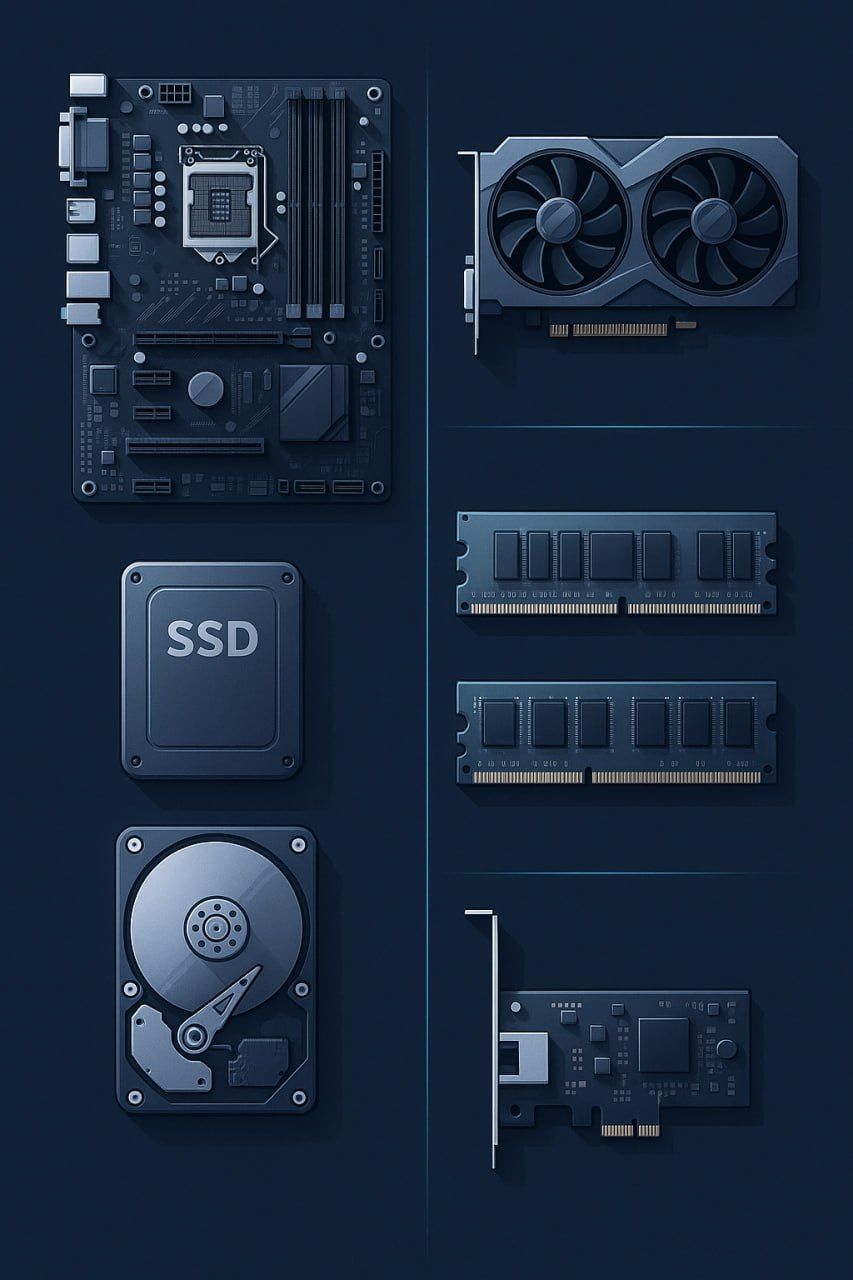
Frequently Asked Questions
How is the HS Code for computer parts determined?
Typically: Motherboard 84733020; RAM and GPU 84733090; SSD 84717030; HDD 84717050; and Network Card 85176290. Final determination depends on technical specs/application/packaging.
What permits are required for imports?
Depending on the item: CE/FCC/RoHS compliance; and, for networking equipment where applicable, permits from the Ministry of Communications/Communications Regulatory Authority. Also safety/quality certificates and complete order registration.
What are the special requirements for packaging and transport?
Use ESD-safe bags, cushioning, temperature/humidity control, and precise labeling on cartons. For sensitive items, transport in standard containers and store in controlled environments.
What is the typical clearance time for computer parts?
It depends on document completeness, HS alignment, required permits, and customs workload. With full documentation and coordination with a specialized broker, the process can be significantly expedited.
Specialized Customs Services by Saba Brokerage
Leveraging a skilled, experienced team in clearing electronic and IT components, this organization provides comprehensive, dedicated services designed to cover all import and export needs and execute clearance quickly, reliably, and at minimal cost.
1. Advanced Expert Consulting
Through detailed market analysis, competitor review, and full understanding of import/export laws and regulations, we offer the best strategies for your imports and clearance. This includes:
Optimized clearance routes: Evaluating all options to select the most suitable path for fast and cost-effective clearance.
Risk identification: Identifying and assessing potential risks such as sudden regulatory changes, transport issues, and customs delays.
Cost-reduction solutions: Practical methods to reduce clearance costs, including tariff reductions, customs discounts, and leveraging special facilities.
2. Fast and Efficient Clearance
With extensive customs experience, we complete every stage swiftly and precisely. Services include:
Handling all customs formalities: From order registration and document preparation to settlement and obtaining required permits, our professional team completes all steps thoroughly.
Ongoing coordination with customs: Broad relationships with various customs houses facilitate clearance and enable swift resolution of any issues.
Real-time tracking and updates: Clients can monitor the status of their goods at any time and track progress online.
3. Full Coordination in Transport and Logistics
In cooperation with reputable domestic and international carriers, we provide comprehensive logistics services:
Selecting optimal transport modes: Choosing air/sea/road based on cargo type, delivery time, and cost.
Safe, standard packaging: Ensuring appropriate packaging to prevent damage in transit.
Warehousing and distribution management: Offering storage and distribution services post-clearance to streamline delivery to the final destination.
4. Strict Adherence to International Standards
We adhere to all international standards and customs regulations:
Standards compliance assurance: Thorough inspection to ensure compliance with CE, FCC, RoHS, and other legal requirements.
Obtaining necessary certificates: When needed, we obtain required certificates for import/export, including health, safety, and environmental compliance.
5. Continuous Support and After-Clearance Services
We provide full, ongoing support:
24/7 support services: Around-the-clock assistance to address questions and potential issues at any stage.
Post-clearance services: Consulting and services for post-clearance processes, including warehousing, distribution, and sales.
6. Risk Management and Continuous Improvement
We continuously improve processes and manage risks related to clearance:
Risk identification and analysis: Analyzing and forecasting potential risks in import and clearance, and providing mitigation strategies.
Ongoing process improvement: Continuously enhancing clearance processes to increase efficiency and reduce client costs.
