• Head Office: Unit 502, 5th floor, No. 222, Kashani Ave, Tehran
  • Working Hours: Sat to wed, 8.30 AM - 5 PM (Tehran Time)
  • Phone

    +989121536145

Customs Clearance of Butanone in Iran (HS Code + Documents and Permits)
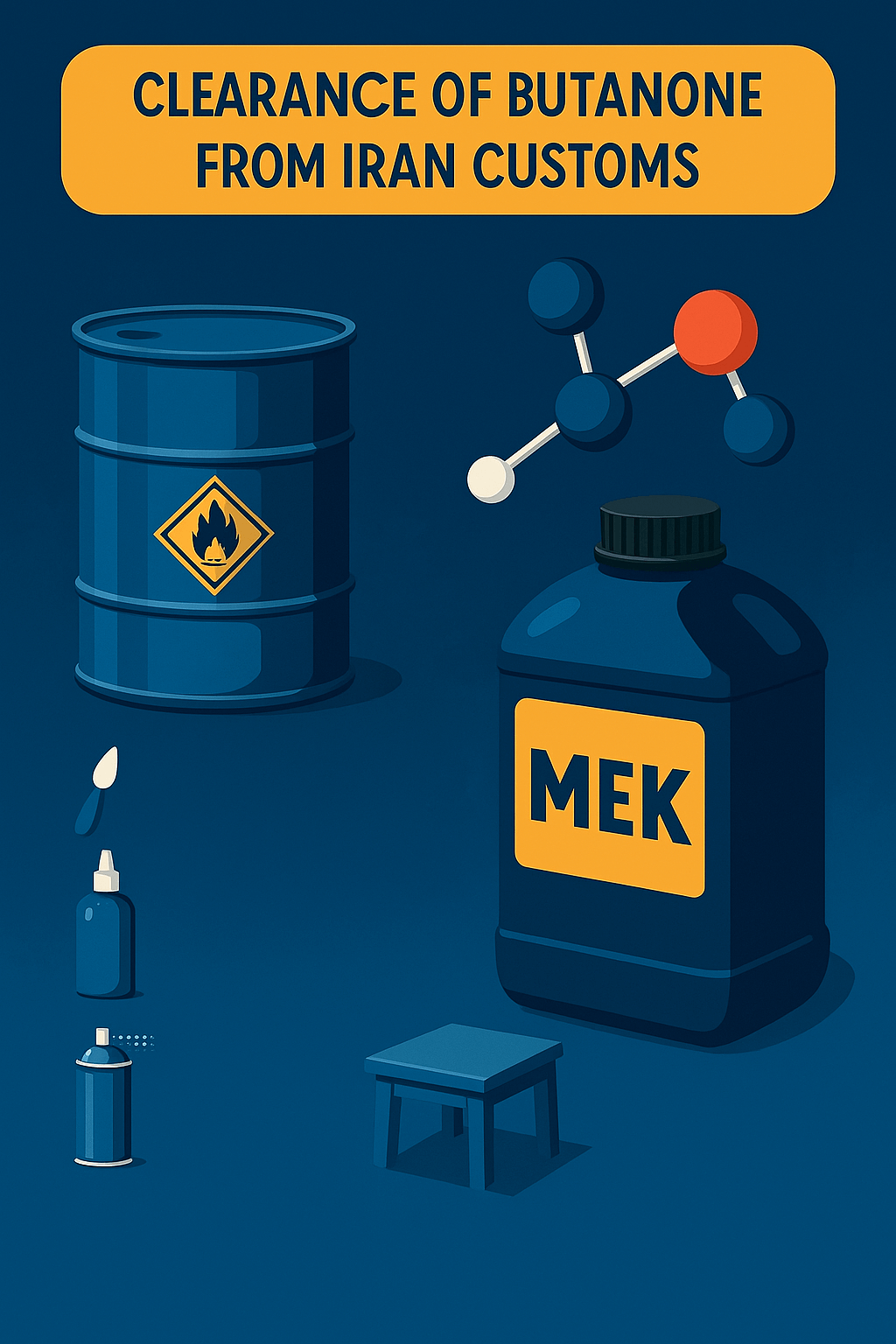
Customs clearance of Butanone (Butanone), also known as Methyl Ethyl Ketone (MEK), is a sensitive and specialized process that requires adherence to technical guidelines and specific customs regulations. Because of its physical and chemical characteristics, butanone is used as a versatile industrial solvent in the production of paints, industrial coatings, adhesives, lacquers, and resins. Accordingly, this substance is critically important across various industries including automotive, furniture manufacturing, printing, and plastics production.
Explanation of this product’s clearance steps

To estimate the time and cost of Butanone (MEK) customs clearance, contact the Saba Tarkhis experts.

Instant Free Consultation

1) Butanone Tariff (HS Code)

According to the international Harmonized System (HS Code), butanone is classified under 29141200. This code covers ketones and diketones and enables the accurate classification of butanone among other chemical compounds. Using the correct HS Code is crucial, as customs authorities rely on it to identify the substance being imported or exported and to precisely calculate the relevant duties. It also helps prevent errors in paying taxes and duties and significantly streamlines the clearance process.

2) Key Steps and Considerations in Butanone Clearance

1. Obtaining the Required Permits

Importing butanone into Iran requires multiple permits from competent authorities. Chief among these is the Department of Environment, which closely supervises the import of chemical and hazardous substances. The Ministry of Health must also provide approval regarding the material’s health and safety. Due to safety and environmental sensitivities, butanone is subject to these regulations and all required permits must be obtained before entry. In addition, in some specific cases, industrial standards and assurances regarding compliance with industrial safety practices are mandatory.

2. Compliance with Safety and Technical Standards

Because of its high flammability and potentially toxic vapors, butanone is considered a hazardous chemical. Therefore, importing this material requires strict adherence to safety protocols. Packaging must prevent leakage and other potential hazards. Technical documentation such as the Material Safety Data Sheet (MSDS) is mandatory to outline risks, specifications, and required safety measures, and must accompany the shipment.

3. Quality Control

A core step in butanone clearance is quality control and a thorough review of the technical analysis. To ensure the purity and quality of imported butanone, customs authorities may request chemical testing at customs. These tests help guarantee safety and industrial usability—especially important because butanone is used in quality-sensitive products like industrial paints and lacquers where impurities can harm the final product.

4. Payment of Taxes and Customs Duties

Duties and taxes for butanone vary based on import volume and destination. Tariffs are calculated under HS Code 29141200, and customs authorities use this code—in line with current regulations—to determine the costs associated with importing butanone. These rates may differ depending on import volume, end use, and country of origin.

3) Specific Conditions for Import and Export of Butanone

In recent years, imports of butanone to Iran have gained importance due to the growing needs of the country’s chemical and manufacturing sectors. This substance is mainly sourced from countries such as China, India, South Korea, and Japan—major global producers that supply the Iranian market with high-quality, competitively priced products thanks to large-scale production. Butanone imports to Iran fluctuate with domestic demand—especially from paint manufacturing, lacquer and industrial coatings, and resin industries—where it is widely used as a strong solvent.

4) Import and Export Volumes

According to customs statistics, average annual butanone imports into Iran have been several thousand tons in recent years. While this amount can fluctuate with economic conditions and sector-specific demand, imports from producing countries continue due to the chemical industry’s sustained reliance on this material.
Iran exports butanone to neighboring countries such as Türkiye, Iraq, Azerbaijan, and some Central Asian states. Although export volumes are lower than imports, Iran’s strategic geographic position and access to nearby markets present growth potential. Over time, Iran could become a regional distribution hub for butanone.
Given that butanone production in Iran is on a smaller scale compared to major producing countries, export volumes are relatively limited—generally reaching several thousand tons annually. Even so, export markets such as Türkiye and Iraq—driven by their industrial demand—remain the primary destinations.
Butanone is a globally demanded chemical used across industrial manufacturing, chemicals, and industrial coatings. Key producing countries include China, the United States, India, South Korea, and Japan, which hold the largest production shares and export worldwide.
Global data indicate that annual butanone turnover on international markets exceeds one million tons. Owing to its broad industrial applications, global demand remains steady. Rising needs in sectors such as automotive, industrial coatings, and paints have secured butanone’s prominent position in the global chemicals market.

5) Major Exporting and Importing Countries

Top Butanone Exporters
The largest butanone exporters include China, the United States, India, South Korea, and Japan. With large-scale production, these countries play a central role in meeting global demand. China—thanks to high capacity and competitive pricing—holds the largest share of global butanone exports.
Top Butanone Importers
The world’s major importers are industrialized and developed countries with significant demand in manufacturing: the United States, EU member states, Canada, Mexico, and Brazil account for a large portion of global butanone imports due to the size of their chemical and manufacturing industries.

6) Required Documents for Butanone Clearance

For customs clearance of Butanone—widely used across industries—specific documents must be presented to customs to confirm compliance with import regulations for chemicals.
1. Bill of Lading
A principal transport document containing shipment details, including consignor/consignee, quantity/type of goods, and carrier information. Issued by the carrier and required for clearance.
2. Commercial Invoice
Provides detailed transaction information—price, quantity, and product type. It serves as an official document between buyer and seller and is used to calculate customs value and duties.
3. Packing List
Details packaging type, number of packages, weight per package, and other specifications—facilitating thorough inspection by customs.
4. Certificate of Origin
Indicates the producing country—usually issued by the Chamber of Commerce—and helps customs apply the appropriate tariff based on origin.
5. Chemical Import Permits
Permits from relevant bodies—such as the Department of Environment and the Ministry of Health—are required due to the hazardous nature of butanone.
6. MSDS (Material Safety Data Sheet)
Provides critical information on hazards, properties, and safety procedures related to butanone. Must be submitted to ensure compliance with safety standards.
7. Customs Declaration
An official statement including details such as type, quantity, and value of goods—prepared by the importer—to initiate clearance.
8. Certificate of Analysis
Confirms quality and purity—usually issued by the manufacturer or an accredited laboratory—and is crucial for chemicals.
9. Order Registration
Registering the order in the Comprehensive Trade System is a mandatory step for chemical imports and includes transaction and import details.
10. Insurance Certificate
Proves the shipment is insured against potential risks during transport and must be presented to customs.
11. Safety and Health Undertakings
In some cases, customs may require undertakings from the importer to confirm adherence to safety and health instructions.
12. Standard Compliance Certificates
Demonstrate that butanone meets technical and safety requirements—mandatory for sensitive chemicals.
Goods Short Description HS Code
Butanone (MEK) Volatile organic solvent; industrial/laboratory 29141200

Final classification may depend on grade, purity percentage, packaging, and end use.

Need precise HS selection, permit acquisition, and document preparation? Our team manages your case end-to-end.

Request a Proforma Estimate
Explanation of this product’s clearance steps

Frequently Asked Questions

What is the HS Code for Butanone?

Butanone (MEK) is typically classified under 29141200; final determination depends on technical specs, purity, and end use.

What permits are required to import Butanone?

Depending on the case: permits from the Department of Environment and the Ministry of Health, submission of MSDS, and compliance with hazardous-materials packaging and labeling standards.

What are the key safety tips for transport and storage?

Store in a well-ventilated warehouse, away from heat/ignition sources; use sealed, resistant containers; segregate from oxidizers; train staff and ensure fire-fighting equipment is available.

Specialized Customs Clearance Services by Saba Brokerage

Saba Brokerage is a leading provider of customs services for chemical goods—including butanone. With many years of experience in clearing chemical cargoes, the company helps importers complete butanone clearance with minimal time and cost.

Specialized Customs Consulting: Our experts guide clients through all regulations governing chemical imports and help manage the clearance process optimally.

Fast Permit Acquisition: We obtain all necessary safety and health permits from the relevant authorities, removing procedural complexity.

Quality Control & Inspection: Ensuring shipment quality is critical. Our team performs the required checks to verify compliance with international standards and customs regulations.

Expedited Customs Follow-up: With timely, precise follow-up, we prevent unnecessary delays and complete butanone clearance with maximum speed and accuracy.

Safe Transport Services: Transporting chemicals requires strict standards. By partnering with reputable carriers, we ensure shipments are moved safely and in line with international norms.

Post-Clearance Support: Our services continue after clearance—helping clients deliver cargo to final destinations quickly and utilize imports effectively.

Leverage our expertise to navigate chemical-goods clearance with ease and precision.

Back to List